Electrical
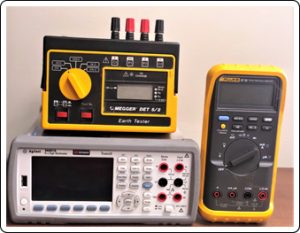 DC/Low Frequency
Indiana Standards Laboratory offers ISO/IEC-17025 accredited calibration of meters and sources in the DC/low frequency range. ISL has used modern and time-tested methods to measure and source DC/low frequency for 50 years. Primary source calibrations are performed using our fixed standards for voltage, resistance, capacitance, and inductance. Secondary source calibrations are performed using our state-of-the-art calibrators that are capable of sourcing, voltage, current, resistance, capacitance, phase, thermocouple, RTD, and time mark. Primary measurements use a bridge comparator, high-accuracy digital multimeter, thermal transfer, or ratio. Secondary measurements use a digital multimeter, current shunt, current transformer, thermocouple indicator, or oscilloscope. All parameters are traceable to a National Metrological Institute such as NIST (US). We are able to calibrate various manufacturers’ instruments, including but not limited to: Fluke, Extech, Amprobe, AEMC, Biddle, Hart Scientific, and Ametek.
| Capacitance (Source & Measure) |
|
| AC Current (Source & Measure) |
|
| DC Current (Source & Measure) |
|
| DC Current (Measure) |
|
| DC Current (Simulated Source) |
|
| Inductance (Source & Measure) |
|
| Magnetometers / Flux Meters |
|
| Resistance Fixed Point (Source & Measure) |
|
| Resistance Ranges (Source) |
|
| Resistance Ranges (Measure) |
|
| Electrical Calibration of RTD Indicators |
|
| AC Voltage (Source & Measure) |
|
| AC High Voltage (Source) |
|
| AC High Voltage (Measure) |
|
| DC Voltage Fixed Point (Source) |
|
| DC Voltage Ranges (Source) |
|
| DC High Voltage (Source) |
|
| DC Voltage Fixed Point (Measure) |
|
| DC Voltage Ranges (Measure) |
|
| DC High Voltage (Measure) |
|
| DC Ratio (Source) |
|
| Thermocouple Simulation |
|
| Oscilloscope Vertical Amplitude DC |
|
| Square Wave |
|
| Pulse Risetime |
|
| Time Mark Source |
|
| Level Sinewave (Source) |
|
| Input Resistance (Measure) |
|
| Input Capacitance (Measure) |
|
RF/Microwave
Indiana Standards Laboratory offers ISO/IEC-17025 accredited calibration of meters and sources in the RF/Microwave range. Using signal generators and power meters that are traceable to a National Metrological Institute like NIST(US). We are able to calibrate various manufacturers’ instruments, including but not limited to: Fluke, Hewlett-Packard, Agilent, Keysight, and Anritsu.
| RF Power (Source & Measure) |
|
| RF Power (Absolute Measure) |
|
| RF Power (Relative Measure) |
|
Why Local Precision Matters for Your Equipment
Maintaining the accuracy of your testing equipment isn’t just about meeting regulatory standards; it’s about protecting the integrity of your entire operation. When your tools drift from their specifications, your product quality suffers, safety risks increase, and you face the potential for costly rework.
Professional electrical instrument calibration in Indianapolis, IN, ensures that your critical measurements remain precise, reliable, and traceable. By partnering with a local accredited laboratory, you gain the peace of mind that comes from knowing your voltage, current, and resistance readings are exactly what they claim to be.
Minimizing Downtime with Regional Expertise
Shipping sensitive instruments across the country for service often results in extended downtime and increased risk of damage during transit. Choosing a provider based in Indiana drastically reduces the time your essential tools are out of commission.
Rapid turnaround times mean your team gets back to work faster, maintaining productivity without sacrificing quality assurance. Furthermore, local access facilitates easier communication and clearer accountability, ensuring that specific calibration requirements—whether for high-voltage sources or delicate RF microwave meters—are understood and met with precision.
Ensuring Compliance & Traceability
In highly regulated industries like manufacturing, aerospace, and medical device production, there is no room for error. Accredited electrical instrument calibration services provide the rigorous documentation required to satisfy auditors and quality control inspectors. Every calibration certificate serves as proof of traceability to National Metrological Institutes like NIST, safeguarding your business against liability.
Investing in expert electrical instrument calibration is a strategic move that solidifies your reputation for excellence. You prevent minor inaccuracies from becoming major operational failures, ultimately saving money and preserving the trust your clients place in your work.